
The best beginner scooter matches your child’s age and size — not the trendiest design in the shop. Children under 5 need a three-wheel model for balance support; children 5 and older can handle a two-wheel kick scooter. Nail the deck height, wheel size, and brake type and you’re set.
Every year thousands of parents buy the wrong scooter for their child’s age or build — and then wonder why their kid won’t touch it. The good news? A few simple checks before you buy make all the difference between a scooter ridden every day and one that gathers dust in the garage.
Some of the links in this article may be affiliate links. If you make a purchase through these links, we may earn a small commission at no extra cost to you. Thank you.
What Are the Key Things to Look For in a Beginner Scooter?
- Three wheels vs two wheels — under-5s need three wheels for stability; age 5 and up can go straight to two-wheel
- Adjustable handlebar height — should sit between hip and waist for comfortable, controlled posture
- Wheel size of at least 120mm — larger wheels roll more smoothly over cracks and uneven ground
- Rear foot brake — the most intuitive stopping method for riders still developing their coordination
- Scooter weight under 3 kg — no more than 30–35% of your child’s body weight for easy handling
What Age Is Right for a First Scooter?
Most children are ready for a scooter between 18 months and 3 years old — as long as you match the right type to the right age. At 18 to 24 months, look for a very low, three-wheel scooter with a wide deck and a handlebar at roughly chest height. The goal at this age is simply getting comfortable pushing with one foot while the other stays planted on the board.
By age 3 to 4, most children can manage a slightly taller three-wheel scooter and start practising lean-to-steer turns. From age 5 onwards, two-wheel kick scooters become the standard — children at this age have enough core balance and coordination to stay upright without the third wheel’s support. Studies of children’s motor development consistently show that matching equipment to developmental stage, rather than chronological age alone, leads to faster skill acquisition and more positive early experiences with physical activity.
One important thing to keep in mind: developmental milestones vary widely. A confident, active 4-year-old might be ready for two wheels earlier than average, while a cautious 6-year-old might prefer the security of three wheels a little longer. There’s no award for skipping a stage — and rushing the transition often sets confidence back rather than pushing it forward.
If your youngest rider is still working on balance and coordination, it’s worth knowing that balance bikes and three-wheel scooters work brilliantly alongside each other for toddlers. Our guide to choosing the best balance bike for your child covers sizing, types, and the key signs of readiness — useful reading if you’re still deciding which first ride fits your child best.
Should a Beginner Start on a Three-Wheel or Two-Wheel Scooter?
This is the question parents ask most often — and the answer is simpler than you’d think. Three-wheel scooters are self-balancing. Two-wheel scooters are not. That single difference changes everything for a beginner.
On a three-wheel scooter, your child can stand still without toppling over. They can look around, wave at a friend, shout at the dog — all without having to think about balance. That freedom lets them focus purely on the fun of scooting, which builds confidence fast. Motor learning research consistently shows that reducing the balance demand in the early stages leads children to practise longer, fall less, and transition to more advanced skills more quickly.
Two-wheel scooters demand active balance from the very first push. That’s absolutely fine for children with solid core strength — typically age 5 and up — but it’s a frustrating introduction for younger children who haven’t yet developed those stabilising muscles. Starting on three wheels doesn’t slow a child down. It gives them a positive first experience that transfers directly to two wheels when the time is right.
| Three-Wheel Scooter | Two-Wheel Scooter | |
|---|---|---|
| Best age range | 18 months – 5 years | 5 years and up |
| Balance required | Minimal — self-balancing | Active balance needed |
| Steering style | Lean-to-steer or handlebar | Handlebar only |
| Typical weight | 2–3 kg | 1.5–2.5 kg |
| Typical wheel size | 120–145mm | 100–200mm |
| Brake included? | Sometimes — always check before buying | Almost always included |
How Do You Get the Right Deck Height and Handlebar Fit?
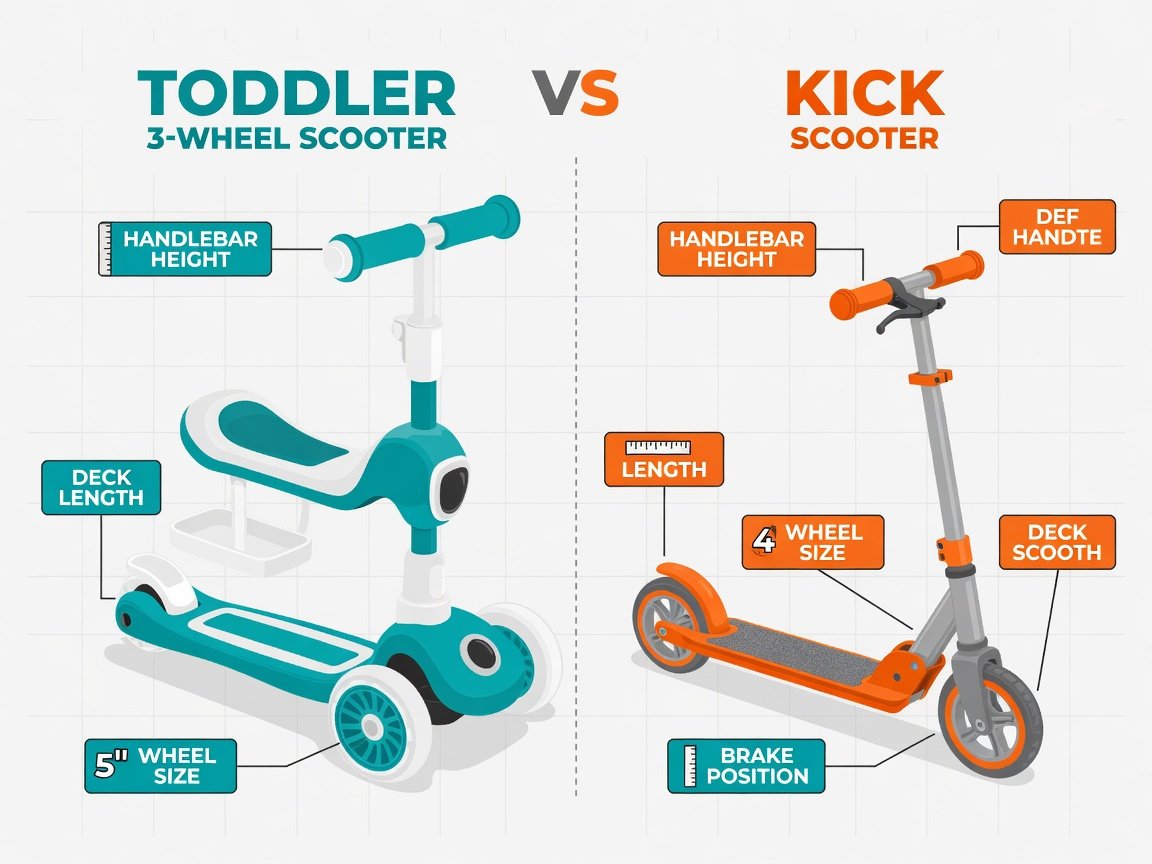
Handlebar height is the single most common fit mistake parents make when buying a beginner scooter. A handlebar that’s too high forces your child to reach up, putting strain on their shoulders and making steering harder than it needs to be. A handlebar set too low makes them hunch forward, throwing off their balance and tiring them out much faster.
The golden rule: the handlebar should sit between hip height and waist height when your child stands on the deck in normal shoes. Hip height gives a more relaxed cruising posture. Waist height gives more direct control — which suits beginners who are still finding their balance. Either position is fine; what matters most is that it isn’t above the belly button.
Most good beginner scooters have adjustable handlebars, which means one scooter can grow with your child across two or three years of riding. Before you buy, check that the adjustment collar locks securely. A handlebar that slips mid-ride is both frightening and dangerous — and it’s one of the most common quality issues on cheaper beginner models.
Deck length matters too, though it’s less critical than handlebar height. A longer deck gives more foot-planting room, which feels reassuring for nervous beginners. For children aged 3 to 5, look for decks around 30–36 cm long. For ages 5 to 8, a deck in the 35–44 cm range tends to suit most children well and leaves room to grow into the scooter.
What Wheel Size Is Best for a Beginner Scooter?
Wheel size directly affects how smooth and stable a scooter feels — especially on the real-world surfaces beginners ride on, like cracked pavement, gravel paths, and small kerb drops. Getting wheel size right is one of the most practical things you can do to set a beginner up for success.
Smaller wheels in the 76–100mm range are lighter and more responsive, but they feel every bump in the ground. That’s fine for experienced riders who want agility and control, but for a beginner it creates a jarring, unpredictable ride that quickly erodes confidence. Larger wheels in the 120–200mm range absorb much more surface variation, roll faster with less push effort, and give beginners the kind of smooth, flowing experience that makes them want to keep going.
For toddler and pre-school scooters, 120–145mm wheels are the norm and work well on most surfaces. For school-age beginners, 120–180mm is the sweet spot — enough rolling smoothness without adding significant weight to the scooter. Pneumatic (air-filled) wheels give the smoothest ride of all, but they need occasional inflation and can puncture. For most beginners, solid polyurethane wheels in the 120–180mm range offer the best balance of comfort, durability, and zero maintenance.
What Type of Brake Does a Beginner Scooter Need?
Brakes on a kids’ scooter come in two main types: rear foot brakes and hand-lever brakes. For beginners, the rear foot brake wins almost every time — and understanding why makes it easier to spot the right scooter quickly.
A rear foot brake is a small rubber pad mounted above the rear wheel that the rider presses down on with their foot to slow down. It’s intuitive even for very young children because it mimics dragging your foot — which is exactly how most beginners naturally try to stop anyway. Motor learning research shows that matching a new skill to an existing natural movement pattern cuts learning time dramatically. With a foot brake, children are stopping correctly almost from their very first session.
Hand-lever brakes, by contrast, require the rider to remember to squeeze a lever while simultaneously balancing and steering. That’s significant cognitive load for a 4- or 5-year-old. Hand brakes are more precise and are standard on older children’s and adult scooters — but for a first scooter, they introduce unnecessary complexity. Save them for when your child is confident and ready to progress.
One exception worth knowing: some very basic toddler scooters designed for under-2s include no brake at all. At walking speeds on a flat, enclosed surface, that’s usually acceptable. But once your child is scooting at any real pace, or anywhere near a road or slope, a working brake is non-negotiable. Always check before you buy.
How Heavy Should a Beginner Scooter Be?
Scooter weight is one of those specs parents often overlook until they watch their child struggling to pick it up after a fall — or refusing to carry it back to the car. A heavy scooter that a child can’t easily manoeuvre or lift quickly becomes a liability rather than a joy.
A practical guideline: a beginner’s scooter should weigh no more than 30–35% of your child’s body weight. For a 15 kg (33 lb) four-year-old, that means looking for scooters under 5 kg. Most quality beginner scooters fall between 1.5 kg and 3.5 kg, which keeps them genuinely manageable for small riders across a long afternoon of riding.
Weight also affects how long and how far a child will actually ride. A lighter scooter takes less effort to push and accelerate, which means longer sessions, more exercise, and — most importantly — more fun. That’s exactly what you want in the early stages when you’re building the habit and the love of riding, not just the skill.
How Much Should You Spend on a Beginner Scooter?
The $25 scooter from a discount store might look like a smart buy, but it almost always costs more in the long run — either through a quick replacement when it breaks, or through a child who decides scooting is “too hard” because the equipment is working against them.
For a genuine beginner scooter that will last two to three years of regular riding, budget between $40 and $100. In that range you typically get:
- Properly sized, smooth-rolling polyurethane wheels (not hollow plastic)
- An adjustable handlebar that locks securely at every height
- A deck wide enough for small feet to plant confidently
- A reliable rear foot brake
- A total weight under 3 kg
Spending over $150 on a first scooter is rarely necessary unless you’re buying for a taller or heavier child and need a more robust frame. Save the premium investment for when your child has outgrown their starter model and you know they’re genuinely committed to riding. At that point, a better scooter is a worthy upgrade.
If you’re weighing up whether to buy a scooter or a balance bike for a younger child, it’s worth getting across the differences before committing. Our guide to choosing a balance bike covers sizing, types, and which developmental stage each option suits best.
What Safety Gear Does a Beginner Rider Need?
Beginner riders fall. That’s not pessimism — it’s physics. The question isn’t whether they’ll come off, but whether the right gear is in place when they do. Getting safety equipment sorted before the first ride is just as important as choosing the right scooter.
The non-negotiables for any beginner scooter rider:
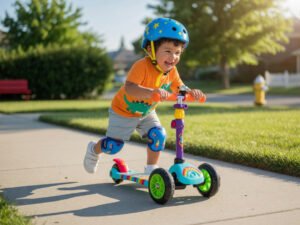
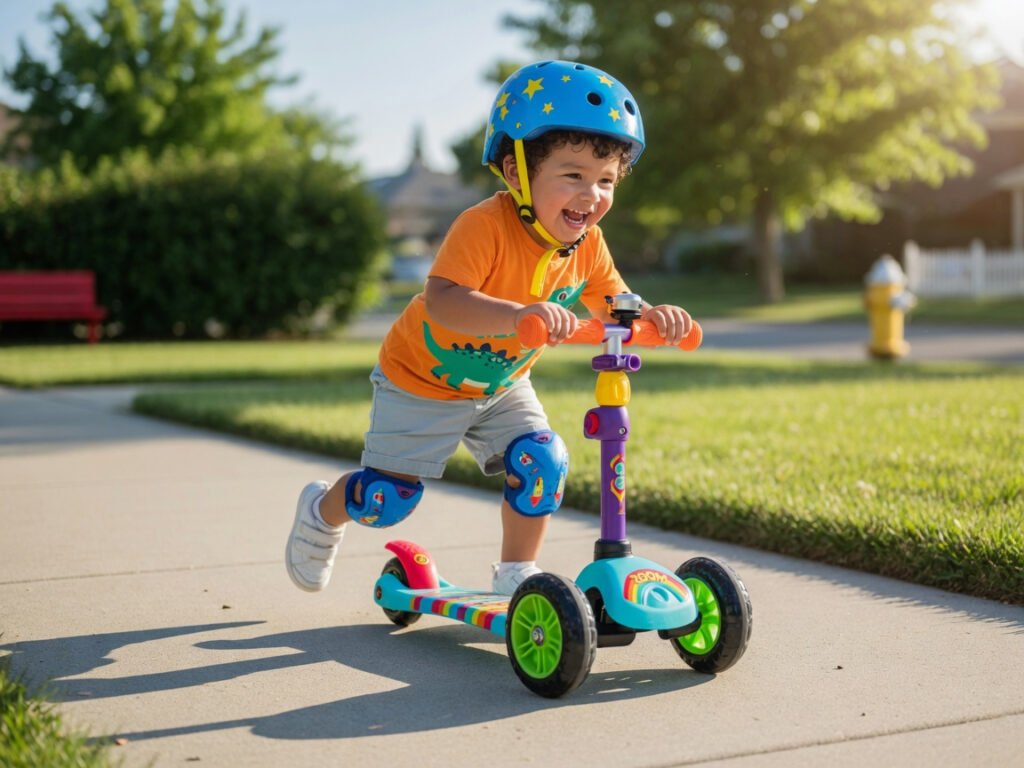
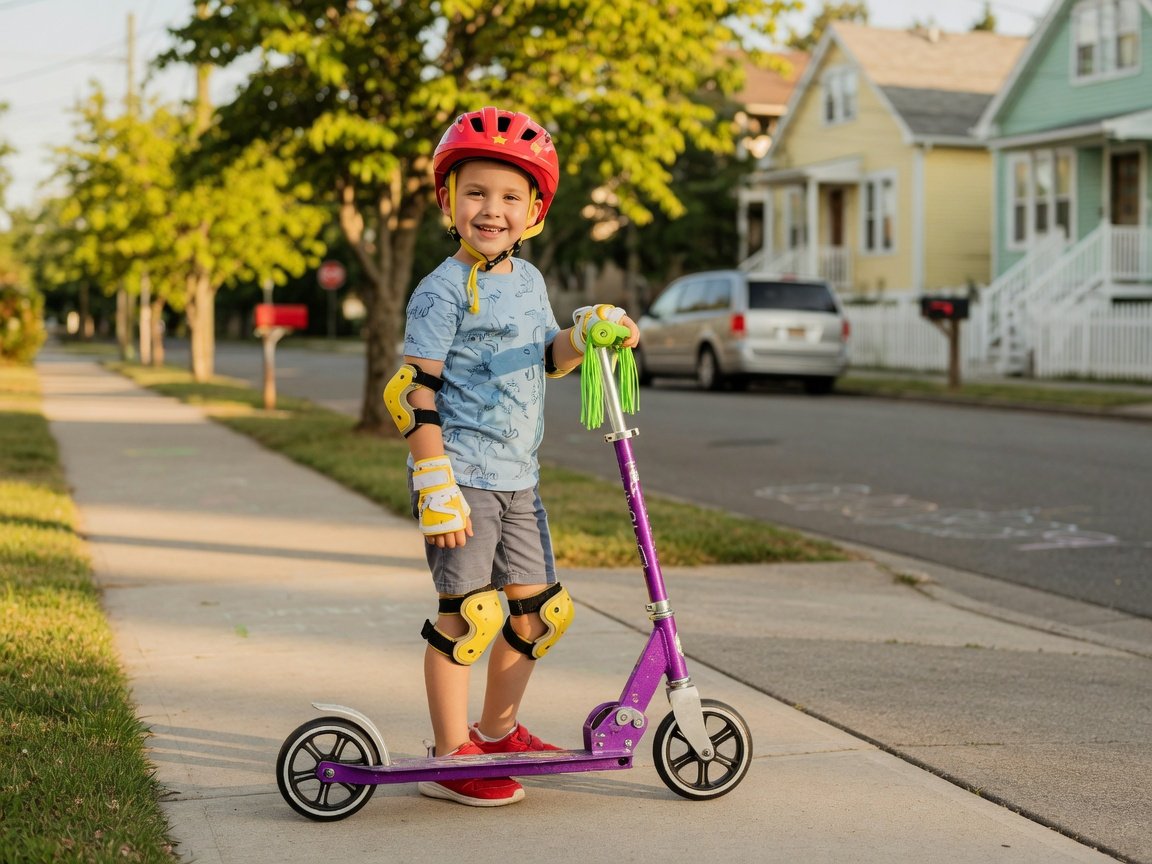
- Helmet — correctly fitted with the front edge sitting two fingers above the eyebrows. A multi-sport helmet is fine for beginners; look for CPSC, EN 1078, or ASTM F1492 certification.
- Knee pads — knees are the most common contact point in a typical beginner fall.
- Wrist guards — instinctive outstretched-hand landings are the leading cause of scooter-related wrist injuries in children.
- Closed-toe shoes — no flip-flops or open sandals. Proper footwear provides grip on the deck and protects toes from accidental wheel contact.
Elbow pads make a great addition too, especially for very young or particularly cautious riders. Some parents worry that kitting a child out in pads will put them off riding — but research into injury psychology consistently shows the opposite. Children who feel adequately protected are more willing to take the small, calculated risks that build genuine skill, while unprotected children often become overly hesitant after their first knock.
If you’re planning to ride together or want to understand the rules around children on scooters near roads, our post on whether you can take a child on a scooter covers the key rules and safety considerations worth reading before you head out.
How Do You Know When Your Child Is Ready to Move On?
Children progress at their own pace, but there are clear signals that your child has outgrown their beginner scooter and is ready for something more advanced. Knowing when to upgrade matters — staying too long on an undersized or underpowered scooter can actually hold back development by limiting what a child can practise.
- They’re riding confidently at speed without wobbling or using the brake constantly
- They’re attempting small tricks — tiny jumps, sharp turns, or riding one-footed
- The handlebar is at its highest adjustment and still feels low
- They’re asking for a “proper” scooter after watching older kids ride
- They’re getting frustrated by the limitations of their current model
For a child moving from a three-wheel scooter to a two-wheel model, the transition is usually quick once they’re developmentally ready — because all the core scooting mechanics are the same. The main adjustment is learning to balance while stationary, which most children master within a few short sessions when they’re ready. Don’t force it before that moment arrives.
Once your child is ready to make the move to two wheels, our step-by-step guide to learning to ride a kick scooter walks through the whole process in a way that keeps things fun and builds confidence at every stage. And once they’re up and riding, the beginner’s guide to riding a kick scooter covers foot placement, posture, cornering, and braking technique in full detail.
Frequently Asked Questions About Choosing a Beginner Scooter
What age is a scooter suitable for a beginner?
Children as young as 18 months can start on a low, wide three-wheel scooter designed for toddlers. Most children are ready for a standard two-wheel kick scooter from around age 5, though confident 4-year-olds with good balance sometimes make the jump a little earlier. Always follow your child’s developmental readiness over the age numbers on the box.
Is a three-wheel or two-wheel scooter better for a beginner?
Three-wheel scooters are better for children under 5 because they self-balance, letting kids focus on steering and pushing rather than staying upright. Two-wheel scooters suit children 5 and older who have the core balance and coordination to stay stable. Starting on three wheels doesn’t slow development — it builds the positive early experience that carries over to two wheels quickly.
What size scooter does a beginner need?
The handlebar should sit between your child’s hip and waist when they stand on the deck. For children aged 3 to 5, look for adjustable handlebars that start around 55–70 cm from the ground. For ages 5 to 8, models adjustable from 65–80 cm work well for most children. Always measure your child rather than relying on the age guide alone.
How much should you spend on a beginner scooter?
Between $40 and $100 covers a reliable beginner scooter with quality wheels, a secure adjustable handlebar, and a proper rear brake. Avoid models under $25 — they tend to be too heavy, have poor-quality wheels, and make learning harder than it needs to be. There’s rarely any need to spend more than $100 on a child’s first scooter.
Does a beginner scooter need a brake?
Yes — any scooter used at real speeds or anywhere near a road should have a working brake. A rear foot brake is the best choice for beginners because it’s intuitive and doesn’t require the rider to coordinate a hand squeeze while simultaneously balancing and steering. Some very basic toddler models skip the brake entirely, which is only acceptable on completely flat, enclosed surfaces at very slow speeds.
What’s the safest scooter for a beginner?
The safest beginner scooter is one correctly sized for your child’s age and height, weighing less than 35% of their body weight, with a working rear foot brake and smooth-rolling wheels of at least 120mm. Pair it with a properly fitted helmet, knee pads, and wrist guards and you’ve addressed the most common injury risks before the first ride even starts.
Can a 2-year-old ride a scooter?
Yes, with the right scooter. Look for a model designed specifically for toddlers — one with a very low deck (under 10 cm from the ground), a wide base, three wheels, and a handlebar at about chest height for a 2-year-old. At this age the goal is simply getting comfortable on a moving platform, not speed or distance. Keep sessions short, on flat ground, and always supervised.
The Bottom Line: How to Choose a Scooter for a Beginner
Choosing the right beginner scooter doesn’t have to be complicated. Match the scooter type to your child’s age — three wheels for under-5s, two wheels from age 5 onwards. Make sure the handlebar is adjustable and sits between hip and waist height. Look for wheels of at least 120mm for a smooth, confidence-building ride. Insist on a rear foot brake. Keep the total weight under 3 kg. And spend between $40 and $100 for a model that will genuinely last.
Do those five things and you’ll almost certainly land on a scooter your child wants to ride every single day — which, when it comes down to it, is the whole point.
Your next steps before you buy:
- Measure your child’s hip and waist height to establish the handlebar range you need
- Decide three-wheel or two-wheel based on your child’s current age and balance confidence
- Check the scooter weight against the 30–35% of body weight guideline
- Confirm the wheel size is at least 120mm and a rear brake is included
- Order matching safety gear — helmet, knee pads, wrist guards — at the same time as the scooter
- Head out on the first ride on a flat, quiet surface and let the fun do the rest