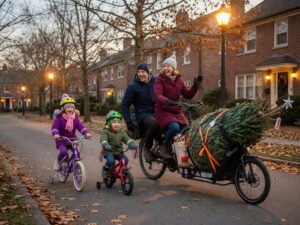
Yes — you can absolutely carry a Christmas tree on a cargo bike. A 5–6 ft tree fits comfortably on most longtail or front-box cargo bikes using nothing more than two ratchet straps. No car, no roof rack, and no stress — just a ten-minute load and a genuinely memorable festive ride home.
What You Need to Know at a Glance
- Most cargo bikes handle trees up to 6–7 ft without modification. A standard tree weighs just 10–25 lbs — far below the 100–200 kg payload most cargo bikes are built for.
- Two ratchet straps are the essential piece of kit. Bungee cords alone are not secure enough for a bulky, uneven load like a Christmas tree.
- The bike ride produces near-zero operational carbon emissions — compared to the typical 120–150g CO₂ per km of a petrol family car on a 3–5 mile round trip to a garden centre.
- A bike trailer is an excellent alternative if you don’t own a cargo bike — and it handles larger trees than most longtail decks can manage comfortably.
Can You Really Carry a Christmas Tree on a Cargo Bike?
The short answer is yes, and it is far less dramatic than it sounds. A typical 6 ft Nordmann fir — the UK’s most popular Christmas tree variety — weighs somewhere between 12 and 20 lbs once the root ball or base is trimmed. Compare that to the rear deck load capacity of a mid-range longtail cargo bike, which handles at least 100 kg, and a tree barely registers as a challenge for the machine itself.
Some of the links in this article may be affiliate links. If you make a purchase through these links, we may earn a small commission at no extra cost to you. Thank you.

The challenge isn’t weight — it’s shape. A Christmas tree is long, tapered, and bushy. Getting it netted tightly before loading is the single most important step. Most tree farms and garden centres net the tree at the point of purchase, compressing it to roughly 10–14 inches in diameter. A tightly netted tree behaves more like a long, lightweight parcel than a prickly, wind-catching obstacle. “Think of the netting as your most important piece of cargo equipment,” says a senior instructor at a leading UK cycling training organisation. “A netted tree loads in minutes. A loose one takes four times as long and never sits as securely.”
Experienced cargo bike families consistently report that the first attempt always feels more nerve-wracking than it actually is. Once you’ve done it once, the process takes under ten minutes and the ride home feels no different to carrying any other oversized load. In 2026, with cargo bike infrastructure improving across UK cities, there has genuinely never been a better time for families to try it.

What Size Christmas Tree Can a Cargo Bike Carry?
Tree size is the first question most people ask before attempting the ride. The reassuring reality is that most standard household trees fit without any special modifications. A 5 ft tree is a comfortable load on almost any cargo bike configuration. A 6 ft tree works well on a longtail, a front-box cargo bike, or a flatbed. A 7 ft tree is doable — but you’ll want a longer longtail deck or a trailer to handle it safely and keep road presence manageable.
| Tree Height | Approximate Weight | Best Cargo Setup | Key Notes |
|---|---|---|---|
| 4–5 ft | 8–12 lbs | Any cargo bike, rear rack, or trailer | Easiest option — fits almost anywhere with minimal strapping |
| 5–6 ft | 12–20 lbs | Longtail, front-box cargo bike, flatbed | The standard choice for most families — ideal balance of size and manageability |
| 6–7 ft | 18–28 lbs | Long longtail, bakfiets, bike trailer | Will overhang the rear wheel — use a bright flag or rear light on the tip |
| 7 ft+ | 25–40 lbs | Bike trailer or extended flatbed cargo bike | Trailer strongly recommended; mark all overhang clearly before setting off |
The key measurement is not just height — it is diameter after netting. A well-netted tree compresses to roughly 10–14 inches wide, which sits comfortably on a rear deck or inside a front box. If the seller will not net the tree, always bring your own cargo net and bundle it yourself before loading. A loose, fluffy tree catches the wind badly at speed, shifts on corners, and takes significantly longer to strap down securely.
Which Type of Cargo Bike Works Best for Carrying a Tree?
Not all cargo bikes are equally suited to Christmas tree duty. The three most common configurations each have real strengths, and the best option depends on what you already own and ride regularly.
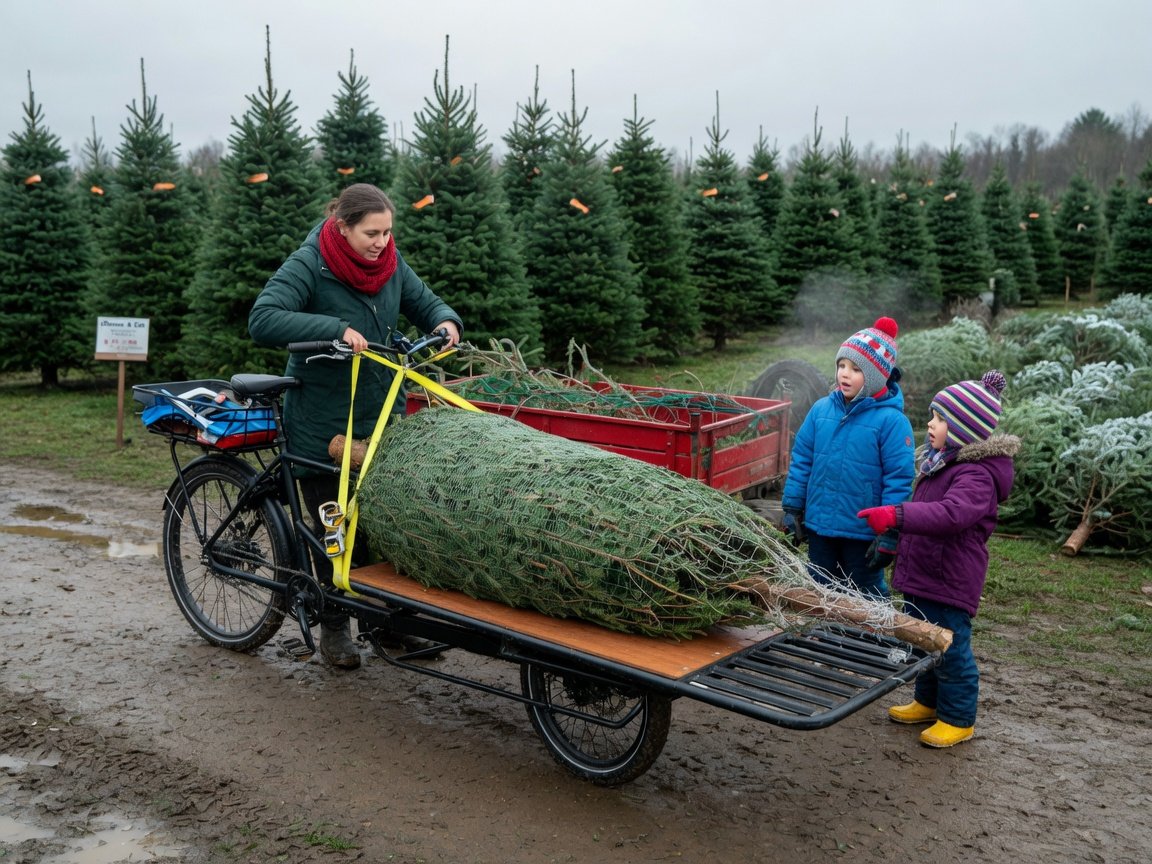
Longtail cargo bikes — such as the Yuba Mundo, Tern GSD, or Riese & Müller Multitinker — have an extended rear deck typically 80–100 cm long, which is ideal for a netted tree laid lengthways with the heavier base towards the rear axle. Two ratchet straps hold the load securely: one near the base and one towards the mid-point. The tree tip will usually overhang the rear wheel slightly. Under UK law, a load overhanging by more than 1 metre must be marked with a bright flag or a flashing rear light — always do this, even on a quiet route home.
Front-box cargo bikes (bakfiets style, such as the Babboe City or Riese & Müller Load) have a large wooden or composite box at the front. A 5–6 ft netted tree often fits diagonally inside the box, completely contained and out of the wind. The trade-off is that your children cannot also ride in the box on the return trip — plan for them to cycle alongside, ride in a separate trailer, or walk a short distance home. A bungee cargo net over the top of the box adds extra security.
Electric cargo bikes make the whole experience noticeably more relaxed, especially if you are riding home uphill or into a headwind with a tree on board. The added weight barely registers with a good mid-drive motor. If you have been weighing up whether to go electric, seasonal practicalities like this are exactly the kind of real-world use case that tips the balance. The benefits of riding an electric cargo bike with your kids go well beyond the school run — the festive tree run is just one more reason on a long and growing list.
What Equipment Do You Actually Need?
Getting the kit right before you go is what separates a smooth festive ride from a roadside tree-untangling session. The good news is that you do not need much — and everything on this list is cheap, reusable, and useful year-round for other cargo loads.
- Ratchet straps (x2 minimum): 25 mm width, 1.5–2 m long. Far more secure than bungee cords for a bulky, irregular load. Available from hardware stores for a few pounds each and rated to 250–500 kg working load — serious overkill for a 15 lb tree, which is exactly what you want.
- Heavy-duty cargo net: A bungee cargo net adds a secondary security layer and stops loose branches catching the wind or snagging on passing obstacles during the ride.
- Rear overhang flag or flashing light: If the tree tip extends past the rear wheel, you must mark it clearly. A bright orange flag or a flashing red light clipped to the end of the tree is both legally required for overhangs over 1 metre and genuinely helpful for visibility.
- Gardening or work gloves: Christmas trees are prickly and sappy. A pair of gloves makes loading and unloading far more comfortable and keeps your hands clean for the ride.
- One spare strap: Bring a backup in case a branch gets in the way of a clean fixing point on the bike frame.
Step-by-Step: How to Load and Strap Your Tree
Loading the tree correctly takes about ten minutes and makes the difference between a confident, stable ride home and a wobbly, nerve-shredding one. Follow this sequence every time and it will quickly become second nature.
- Get the tree netted at the farm. Ask the seller before you pay — most will do it on the spot. If not, use your own net and bundle it tightly before attempting to load onto the bike.
- Park on flat ground. Load on level ground with your kickstand fully deployed. A slope makes the whole process awkward and increases the risk of the bike tipping mid-load.
- Orient the tree base-first. Lay the tree lengthways with the heavier base towards the rear axle on a longtail. This positions the heaviest part over the wheel and keeps the centre of gravity low and stable.
- Apply your first ratchet strap. Fix one strap around the lower third of the tree, pulling it firmly against the deck. Firm, not crushing — you want the strap to bite without damaging the netting or compressing the trunk.
- Apply your second ratchet strap. Fix the second strap around the upper section of the tree, at least 40 cm above the first. Give the tree a firm lateral shake — it should not move side to side.
- Throw the cargo net over the whole load. Hook it to the frame anchor points as a secondary layer. This catches any branch that shifts or loosens during the ride home.
- Mark any rear overhang. If the tip extends past the rear wheel, clip on your flag or rear light before you move. Do not skip this step, even for a short trip.
- Walk the bike forward a few metres before mounting. A correctly loaded tree should feel like carrying any other long parcel — not like a sail. Only mount and ride when everything feels stable and balanced.
What About Using a Bike Trailer Instead?
If you do not own a cargo bike, a bike trailer is an excellent alternative — and in several ways it is actually the easier option. A standard double-child trailer has enough internal space for a 5–6 ft netted tree laid diagonally. Larger cargo or singletrack trailers handle 7 ft trees comfortably. The tree sits low to the ground, contained between two wheels, and does not affect your main bike’s handling at all.
The big practical advantage is stability. Because the load is below and behind the main bike — rather than on top of it — cornering and braking feel entirely normal. You’re also adding no height to your overall load, which matters if you’re passing under low barriers or navigating into covered market areas. The main adjustment is total length: give yourself significantly more space when turning and allow extra stopping distance. Take wider lines through corners and stay off fast roads entirely.
If you already use a trailer for family outings, the Christmas tree run is simply another job for a piece of kit you already know well. Bike trailers are one of the most versatile ways to carry both kids and gear on the road — and a Christmas tree is just a particularly festive form of oversized cargo. For smaller trees, even a modest single-wheel cargo trailer will handle the job without any fuss.
How Do You Stay Safe on the Ride Home?
Riding with an oversized load needs a few small adjustments to your usual cycling habits. None of them are complicated, but thinking through them before you set off — especially on a busy December weekend when the roads are full of other families making the same trip by car — makes a real difference to confidence and safety on the road.
- Take quieter routes. Avoid fast A-roads where possible. Stick to 20 mph zones and back streets where you have more space to manoeuvre the loaded bike without pressure from traffic.
- Allow significantly more stopping distance. The added length and slight extra weight of the tree changes how the bike decelerates. Leave a larger gap to the vehicle in front than you normally would.
- Check your load at the halfway point. Stop after 5–10 minutes and give both straps a firm tug. Trees can settle and shift slightly on uneven surfaces, especially if the netting was slightly loose to begin with.
- Stay visible in December light. Winter daylight fades fast. Front and rear lights are a legal requirement after dark, and bright cycling clothing helps on overcast December days. If the tree overhangs, the rear light you’ve clipped to the tip counts as your main rear light for other road users.
- Ride with a companion on your first attempt. A second rider can spot if the load shifts, help with re-strapping at the roadside if needed, and makes the whole experience feel considerably more festive.
How Does a Cargo Bike Christmas Tree Run Compare to Driving?
The environmental case is straightforward — a cargo bike produces near-zero operational emissions versus roughly 120–150g CO₂ per kilometre for an average petrol family car. But the practical comparison is often more interesting than most families expect, particularly for those living within 3–5 miles of a tree farm or garden centre.
| Factor | Cargo Bike | Car |
|---|---|---|
| Carbon emissions | Near zero (operational) | ~120–150g CO₂/km average |
| Parking at the tree farm | Instant — anywhere near the entrance | Queue, wait, sometimes charged at busy sites |
| Cost of the trip | Zero beyond battery charge (e-bike) | Fuel plus potential parking costs |
| Children’s engagement | Active — they are part of the adventure | Passive — they are passengers |
| Roof rack scratches | Not applicable | A genuine risk every single year |
| Memorable experience created | Almost certainly | Unlikely |
The thing that surprises most families who try this for the first time is not the practicality — it’s how much the children enjoy it. Riding to choose the tree, watching it get loaded onto the bike, and cycling home with it strapped on transforms what is often a stressful December errand into something genuinely memorable. It has all the hallmarks of becoming a proper annual tradition: the kind of thing kids ask about weeks in advance.
This kind of car-free family logistics is explored in depth in our guide to family camping with a cargo bike and no car — if you enjoy the tree run, car-free camping and day trips with the kids are a very natural next step.
What Do Families Who’ve Done It Actually Recommend?
The most useful advice consistently comes from cargo bike families who have already made the December tree run. Here is what experienced riders tell first-timers heading into the 2026 festive season — distilled from hundreds of conversations in the UK family cycling community.
“Start with a smaller tree your first year.” This is the near-universal tip from veteran cargo bike parents. A 5 ft tree is far more forgiving as you work out your strap setup and get a feel for how the loaded bike handles corners and cambers. Once you have done it once, you can scale confidently to 6 or 7 ft the following December. “The first year is about the technique,” as one experienced family cycling advocate with over a decade of cargo biking puts it. “After that, the tree size becomes a non-issue.”
“Go on a weekday if you possibly can.” Tree farms and garden centres are significantly quieter mid-week. You will get more hands-on help from staff with loading, have manoeuvring room without navigating weekend crowds, and face lighter traffic on the route home. Several cargo bike families report taking a morning off work specifically for the trip — universally, they say it is worth it.
“Let the children choose the tree.” Children who ride alongside on their own bikes or travel in the cargo box are far more invested in the whole experience. The ride home — however short — becomes an event in its own right. Research from cycling behaviour studies suggests that once a family makes one meaningful car-free seasonal journey together, they are significantly more likely to repeat and extend that behaviour throughout the year. The tree run, for many families, is exactly that gateway moment.
What Does the Future of Car-Free Festive Shopping Look Like?
Over the next 12–24 months, the infrastructure around cargo biking is improving at a pace that makes ambitious seasonal trips increasingly practical. More UK cities are installing wider, protected cycle lanes capable of comfortably accommodating a cargo bike with a tree strapped on the rear. Tree farms and garden centres are increasingly offering bike-friendly facilities — secure parking areas, staff trained to help with loading, and in some cases dedicated cargo bike collection windows during peak December weekends.
Electric cargo bikes are also getting lighter, more affordable, and longer-ranged as the technology matures. By late 2026, multiple manufacturers have released cargo models under £3,000 with ranges exceeding 80 miles — making a round trip to an out-of-town tree farm a realistic single-charge journey. The solar-powered cargo bike concepts emerging from European manufacturers suggest the next generation of family cargo bikes will be even more self-sufficient for exactly this kind of seasonal adventure.
Culturally, the Christmas tree run by bike is shifting from an eccentric niche into a recognised annual tradition for a growing number of families. Social media content of families arriving home with trees strapped to their cargo bikes has become a festive seasonal staple each December, normalising what was once seen as an unusual choice. Industry data from cargo bike retailers suggests that December is now one of the peak months for first-time cargo bike test rides — with the tree run cited as the specific use case that finally convinced new customers to make the switch.
Frequently Asked Questions
Can I carry a Christmas tree on a regular bike, not a cargo bike?
It’s possible in a limited way but not recommended for anything over 4–5 ft. A regular bike lacks the rear deck or front box needed to support a tree securely. You can balance a small, tightly netted tree across a rear rack with two ratchet straps, but the load affects steering and braking noticeably. For a 5 ft+ tree, a cargo bike or bike trailer is significantly safer and far less stressful.
Do I need any special equipment beyond ratchet straps?
Two ratchet straps are the most important item. Add a cargo net as a secondary layer, a rear overhang flag or flashing light if the tree tip extends past the rear wheel, and a pair of gloves for handling the tree itself. Total cost for the full kit is typically under £25, and you will reuse everything year after year for other loads.
Is it legal in the UK to carry a load that overhangs the rear of a bike?
Yes, with the correct marking in place. UK highway rules require a load overhanging a vehicle’s rear by more than 1 metre to be marked with a bright flag or a flashing red light attached to the end of the load. Keep the overhang to a minimum, use quieter roads, and ensure the marker is clearly visible to drivers approaching from behind. There is no legal prohibition on carrying a Christmas tree by bike as long as the load is secure and properly marked.
What is the maximum tree size I can realistically manage on a cargo bike?
Most families find 6 ft to be the practical sweet spot — manageable to load, comfortable to strap, and within the deck length of most longtail cargo bikes. A 7 ft tree is achievable on a long-deck longtail or with a bike trailer. Anything over 7 ft becomes very difficult to handle safely on a bike alone; for those sizes, a trailer or a car genuinely is the better choice.
How do I stop the tree shedding needles on the ride home?
Keep it netted for the entire journey. Netting compresses the branches and reduces needle drop dramatically compared to a loose tree moving in a car boot or on a roof rack. Leave the net on until the tree is standing in its indoor stand — you will lose far fewer needles than you might expect, and the tree will stay healthier for longer as a result.
Can my children come on the Christmas tree run with me?
Absolutely — and this is genuinely one of the best parts of the whole exercise. On a longtail, children ride on the rear seats to the farm and then cycle alongside (or in a separate trailer) on the return trip while the deck carries the tree. On a front-box cargo bike, children ride in the box to the farm and the box carries the tree home. Many cargo bike families describe the tree run as one of their children’s favourite outings of the entire year.
What if it rains on the way home?
Rain does not harm a Christmas tree — they are outdoor plants accustomed to the elements. The practical concern is your own visibility and road grip rather than the tree. Pack a waterproof jacket, make sure your lights are fully charged before you set off, ride a little slower on wet tarmac, and check that your ratchet straps are quality ones that maintain tension when wet. Most good-quality ratchet straps are completely unaffected by rain — but it is worth a quick test before December arrives.
Ready to Make This a Tradition? Your 2026 Action Plan
Carrying a Christmas tree by cargo bike is one of those tasks that sounds harder than it is. The practical barriers are genuinely low — two straps, a netted tree, a quiet route home — and the reward is a memorable family experience that also happens to be considerably better for the planet. Here is a simple four-step sequence to get ready before the 2026 festive season:
- Now (October–November 2026): Buy two ratchet straps and a cargo net if you do not already own them. Test your bike’s load setup by strapping a bulky box of similar weight to the deck and riding around the block to get a feel for the handling.
- Early December: Find your nearest cut-your-own or choose-and-collect tree farm. Check whether they net trees at point of sale. Plan your quietest route home and identify a good stopping point to check the load mid-ride.
- Tree day: Go early — weekday if possible. Bring the whole family. Let the children choose the tree. Get it netted, load it base-first, strap it down in two points, mark any overhang, and enjoy the ride home.
- Next year: Go a size bigger. By then you will wonder why you ever needed the car for this particular errand.
Once you have done the Christmas tree run by bike, it is genuinely difficult to go back to the car. And if this gets you thinking about everything else a cargo bike can carry — school kit, camping gear, groceries, kids — you are already on the way to a more enjoyable and more sustainable family cycling life. At kidsbikesntrikes.com, we cover the bikes and gear that make exactly that life easier for families at every stage of the journey.