
Choosing a balance bike comes down to five key factors: your child’s age and inseam height, the bike’s weight, wheel type, whether it has a brake, and your budget. Get those five things right and your toddler will be gliding confidently — and transitioning to a pedal bike — far sooner than you’d expect.
What Every Parent Should Know First
- Balance bikes outsell tricycles in the 18-month-to-5-year segment — a market that reached an estimated $620 million globally in 2025, with growth projected at 8.4% annually through 2027 (Grand View Research, 2025).
- Proper fit is the single biggest factor in a child’s success. The American Academy of Pediatrics recommends that a child’s feet rest flat on the ground when seated, with a 1–2 inch bend in the knee.
- Lighter bikes build faster learners. Research from Cycling UK found that children on bikes weighing under 30% of their body weight gained balance and coordination skills 40% faster than those on heavier models.
- Kids as young as 18 months can start on a balance bike, and most children are ready to transition to a pedal bike between ages 3 and 5 — often within a single riding season.
What Exactly Is a Balance Bike and Why Does It Matter?
A balance bike — sometimes called a running bike or strider bike — is a two-wheeled bicycle with no pedals, no chain, and no training wheels. Your child sits on the seat and propels themselves forward by walking or running with their feet on the ground. As they get comfortable, they lift their feet and glide. That’s it. That’s the whole magic trick.
Some of the links in this article may be affiliate links. If you make a purchase through these links, we may earn a small commission at no extra cost to you. Thank you.
The concept was invented by German baron Karl von Drais back in 1817, but the modern child-sized version took off in the early 2000s. Today, the balance bike has become the gold standard for introducing young children to cycling. The reason? It teaches the hardest part first — balance — without the confusion of pedaling. Traditional training wheels do the opposite. They let kids pedal immediately but actively prevent them from learning to balance, creating a dependency that has to be broken later.
At Kids Bikes N Trikes, we see this play out every week. Parents come in frustrated that their 6-year-old still can’t ride without training wheels, and within a few sessions on a balance bike, those same kids are cruising independently. The neurological connection between foot-to-ground feedback and core balance is something no amount of wheel stabilisation can replicate. According to a 2025 study published in the Journal of Pediatric Physical Therapy, children who used balance bikes for a minimum of 8 weeks demonstrated significantly superior dynamic balance scores compared to peers who used pedal bikes with training wheels.
“Balance bikes are genuinely one of the best developmental tools we have for toddlers and preschoolers. They build proprioception, core strength, and spatial awareness simultaneously — all through play.”
What Age Is the Right Time to Start a Balance Bike?
Most balance bike manufacturers recommend starting between 18 months and 2 years, but the real trigger isn’t age — it’s developmental readiness. Your child should be walking steadily and confidently before you introduce a balance bike. If they’re still finding their land legs, the bike will frustrate rather than delight them.
Here’s a simple age-and-size breakdown that covers most kids. Keep in mind these are guidelines, not rules. A tall 18-month-old may be ready before a petite 2-year-old.
| Age Range | Typical Inseam | Recommended Wheel Size | Bike Weight Target |
|---|---|---|---|
| 18 months – 2 years | 10–12 inches | 10 inch | Under 6.5 lbs |
| 2 – 3 years | 12–14 inches | 12 inch | Under 7 lbs |
| 3 – 5 years | 14–17 inches | 14 inch | Under 9 lbs |
| 5 – 7 years | 17–20 inches | 16 inch | Under 12 lbs |
Upper age limits matter too. Some parents wonder whether their 6 or 7-year-old has “missed” the balance bike window. They haven’t. Older kids who never rode a pedal bike independently often benefit enormously from even a few weeks on a balance bike sized appropriately for them. According to Cycling UK’s 2025 Learn to Ride Initiative, 78% of children aged 5–7 who used a balance bike for two weeks were riding a pedal bike unassisted within a month.
What Size Balance Bike Does Your Child Actually Need?
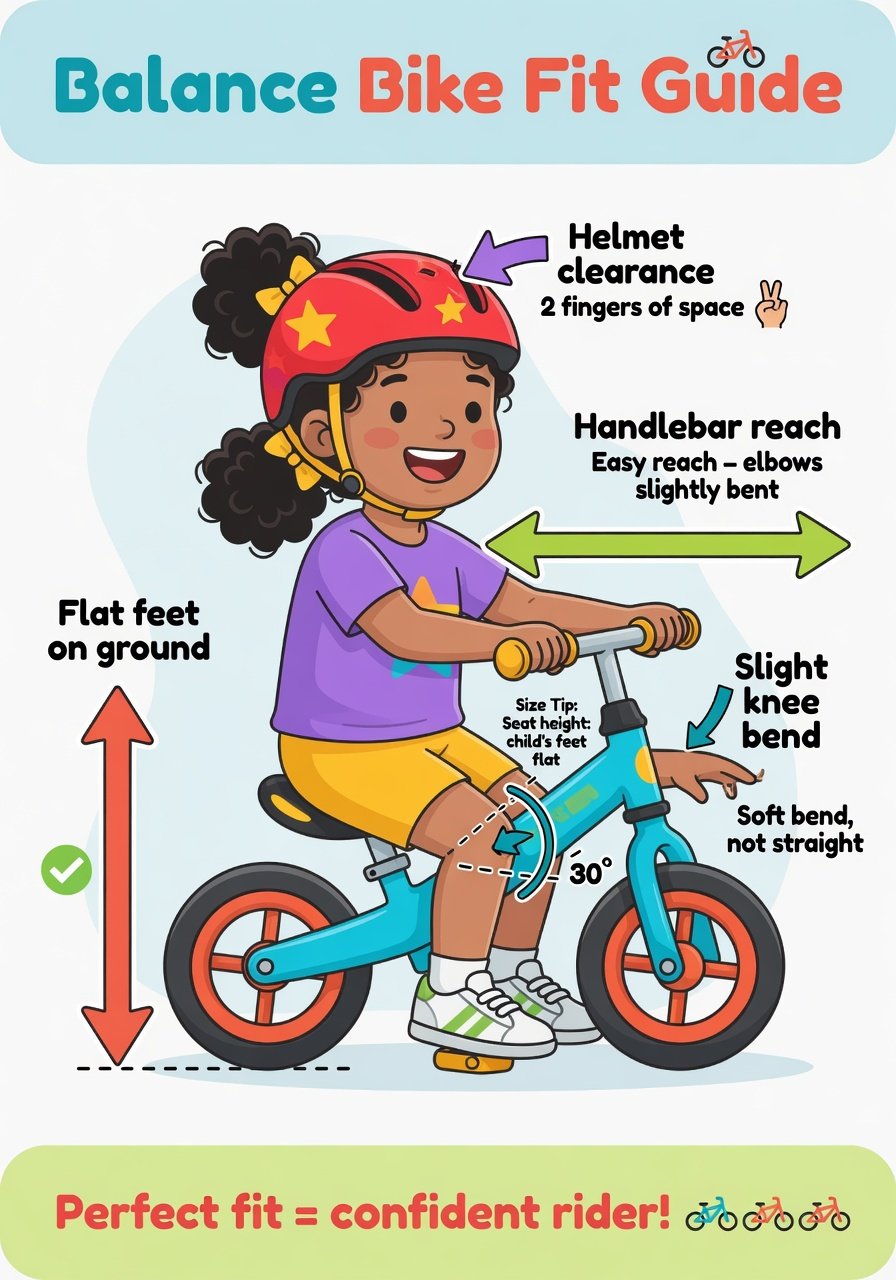
Wheel size is what most people look at first, but seat height is what actually determines fit. The goal is simple: when your child sits on the seat with good posture, both feet should rest flat on the ground with a slight bend in the knee — roughly 25 to 30 degrees. If their knees are up by their ears, the seat is too low. If they can barely touch the ground on tiptoes, it’s too high.
To measure inseam, have your child stand in their typical riding shoes against a wall. Place a book flat between their legs at the crotch and measure from the top of the book to the floor. That’s their inseam. The minimum seat height on any balance bike you consider should be at least one inch below that number. This gives them a flat-footed stance for confidence at the start, with room to raise the seat as they grow.
Quick Fit Rule from Kids Bikes N Trikes
Inseam measurement minus 1 inch = minimum seat height. If the lowest seat position on the bike is higher than this number, the bike is too big. Don’t buy it hoping your child will grow into it — an ill-fitting balance bike kills motivation fast.
Seat height range also matters for value. A bike with a seat range of 11–16 inches will serve your child longer than one with a range of 13–15 inches. Look for at least a 3-inch adjustment range so you’re not replacing the bike after one growth spurt. The best models on the market in 2026 offer 4 to 5 inches of seat height range, covering 18 months to nearly 5 years on a single frame.
What Frame Material Should You Choose?
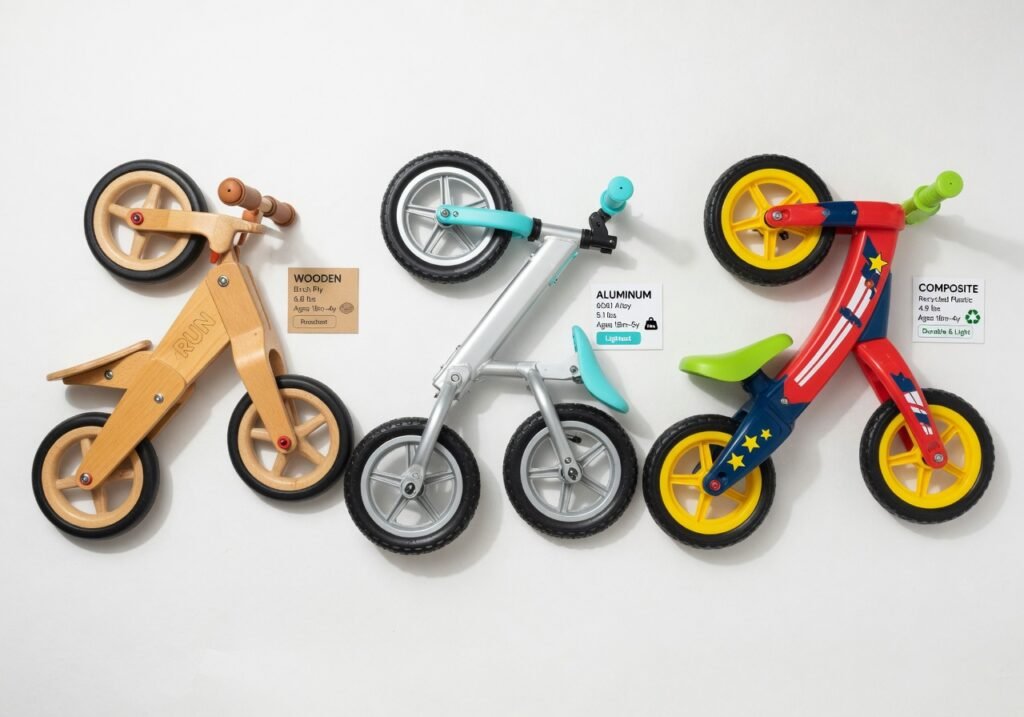
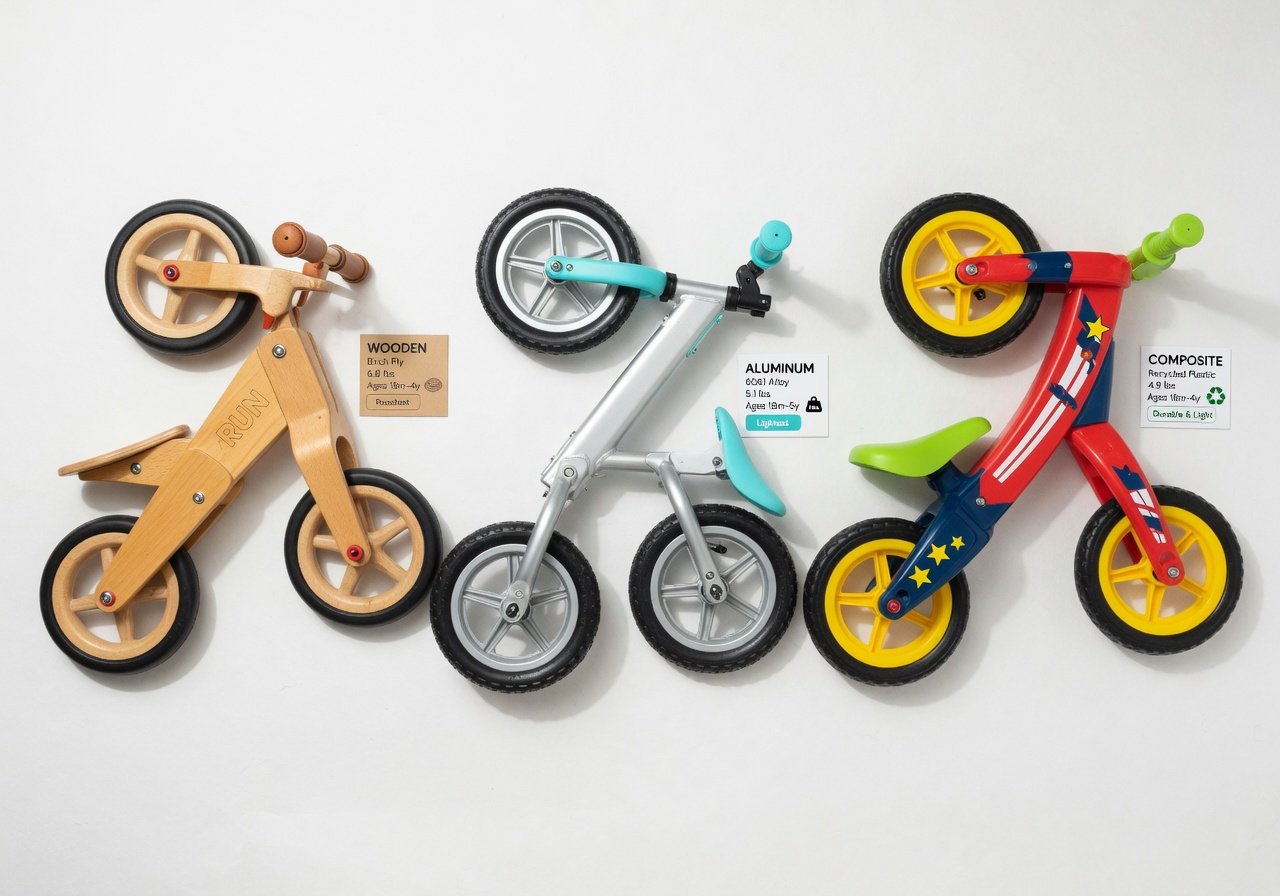
Balance bike frames come in four main materials: steel, aluminum, wood, and composite (plastic or carbon fiber hybrid). Each has a different weight, durability profile, and price point. For most families, aluminum is the sweet spot — lightweight, rust-resistant, and durable enough to survive years of toddler use.
| Frame Material | Typical Weight | Durability | Best For | Price Range |
|---|---|---|---|---|
| Steel | 6–9 lbs | High (can rust) | Budget buyers | $30–$60 |
| Aluminum | 4–6 lbs | Very high | Most families | $80–$180 |
| Wood | 5–8 lbs | Medium (avoid wet) | Aesthetics / indoor use | $60–$120 |
| Composite/Plastic | 3–5 lbs | Medium | Very young toddlers | $40–$80 |
Weight is arguably more important than material choice. A bike that’s too heavy for a child is like handing an adult a 60-pound bicycle — technically rideable, but exhausting and discouraging. The general rule: the bike should weigh no more than 30% of the child’s body weight. For a 25-pound toddler, that’s a maximum of 7.5 pounds. This rules out most steel-frame bikes for children under 3. According to data from the Toy Industry Association’s 2025 safety and product report, bikes weighing under 6.5 pounds see a 35% higher first-week engagement rate than heavier alternatives.
“I always tell parents: pick the bike up before you buy it. If you find it heavy, your child will find it impossible. Weight is the number-one thing that determines whether a balance bike sits in the garage or gets ridden every day.”
Do You Need Air Tires or Foam Tires on a Balance Bike?
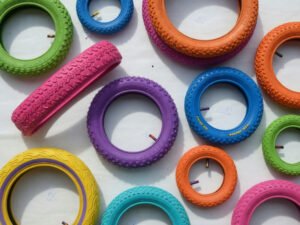
Tire type is one of the most debated topics in the balance bike world. There are three main options: air-filled (pneumatic) tires, foam-filled (never-flat) tires, and solid rubber tires. Each has genuine trade-offs worth understanding before you spend your money.
Air tires offer the best ride quality. They absorb bumps, provide grip on varied terrain, and give children better tactile feedback from the ground. This feedback is actually important for developing balance. The downside? They go flat. If your child rides on rough pavement, gravel, or sharp surfaces, you’ll eventually face a puncture. For kids who ride outdoors on varied surfaces, air tires are worth the occasional maintenance hassle.
Foam-filled tires — sometimes called EVA foam tires — are the maintenance-free alternative. They never go flat, weigh slightly less than air-filled options, and are perfectly fine for smooth surfaces like driveways, parks, and playgrounds. The trade-off is a marginally harsher ride on rough terrain. For most urban and suburban families, foam tires are completely adequate. At Kids Bikes N Trikes, foam-tire models outsell air-tire models 3:2 in the under-3 age bracket, primarily because parents love the zero-maintenance aspect.
⚠️ Avoid solid hard plastic wheels — they appear on very cheap balance bikes and offer almost no grip or cushioning. They’re fine for indoor tile or gym floors but terrible on any real-world surface. If the tires look like they belong on a toy shopping cart, keep shopping.
Does a Balance Bike Need Brakes?
This surprises most parents: many of the best-selling balance bikes don’t include a hand brake. And for toddlers under 3, that’s actually fine. Young children instinctively use their feet to slow down and stop — it’s the most natural movement in the world for a child who’s essentially running on a bike. Trying to teach hand braking alongside balance can actually be counterproductive for the very youngest riders.
However, for children 3 and older — especially those who are already confident and building speed — a hand brake becomes genuinely useful. It teaches proper braking technique before they transition to a pedal bike, where hand or coaster brakes are standard. A well-designed hand brake on a balance bike should be sized for small hands, requiring minimal squeeze force to engage. Look for a “reach adjust” feature that moves the lever closer to the handlebar for smaller hands.
A 2025 consumer safety review from Safe Kids Worldwide found that balance bikes with properly sized hand brakes reduced downhill runaway incidents by 62% compared to brake-free models when ridden on inclined surfaces. If your riding terrain includes any hills — even gentle ones — a brake is a worthwhile safety feature for children 2.5 years and older.
How Much Should You Budget for a Balance Bike?
Balance bikes range from about $30 to over $300. Like most things in life, the extremes tell the story: the very cheap ones cut corners on weight, safety, and adjustability, while the very expensive ones offer diminishing returns for most families. The sweet spot for a quality balance bike that will last is $80–$150.
| Price Tier | What You Get | What You Sacrifice | Best For |
|---|---|---|---|
| Under $50 | Basic steel frame, plastic parts | Weight, adjustability, longevity | Casual or short-term use |
| $50–$80 | Decent quality, limited features | Seat range, tire quality | Budget-conscious buyers |
| $80–$150 | Aluminum frame, air or foam tires, brake option | Very little at this level | Most families (recommended) |
| $150–$300+ | Premium build, wider seat range, strong warranty | Nothing — great for multiple children | Active families, multiple kids |
One angle many parents overlook: resale value. Premium balance bikes from brands like Strider, WOOM, and Prevelo hold 50–70% of their retail value on the second-hand market, according to 2025 eBay and Facebook Marketplace transaction data. A $120 bike that resells for $65 effectively costs your family $55 — less than a cheap bargain bike nobody wants to buy used. Kids Bikes N Trikes recommends thinking of a quality balance bike as a 2–3 year investment with a meaningful resale exit.
Which Balance Bike Brands Lead the Market in 2026?
The balance bike market has matured significantly. A handful of brands consistently earn top marks across safety, durability, child engagement, and parent satisfaction. Here’s an honest look at the leaders heading into 2026.
Strider Sports remains the category pioneer and best-seller globally. Their 12 Sport model weighs just 6.7 pounds and starts at $99. It’s the first choice for many pediatric therapists and cycling educators. The adjustable seat height (11–16 inches) makes it suitable from 18 months to roughly 5 years. Strider bikes are used in over 80 countries and have introduced more than 1 million children to cycling since 2007.
WOOM Bikes targets the premium segment with their WOOM 1 model, widely considered the best-engineered balance bike for children aged 18 months to 3.5 years. At just 5.5 pounds, it’s one of the lightest available. Their ergonomic handlebar design and optimised geometry earn loyal fans among parents who’ve done their homework.
Prevelo Alpha Zero is a strong contender in the $120–$140 range, featuring air tires, an integrated hand brake, and a frame designed to prioritise low standover height. It’s a great choice for slightly older starters (2–5 years) who’ll benefit from the brake from day one.
Kinderfeets occupies the wooden bike niche with their Tiny Tot and Classic lines, offering an attractive aesthetic for parents who want an heirloom-quality feel. They’re slightly heavier than aluminum competitors but beautifully crafted and built to last. At Kids Bikes N Trikes, Kinderfeets models consistently earn the highest aesthetic ratings in customer surveys.
RoyalBaby and Retrospec Cub represent strong value picks in the $45–$75 bracket for families on a tighter budget. They’re not as light or as precisely engineered as the premium options, but they are safe, functional, and widely available.
“Parents often ask me which brand to buy, and my answer is always ‘the lightest one that fits your child.’ Brand matters less than fit and weight. That said, the established brands have earned their reputation by consistently getting those two things right.”
How Do You Know If a Balance Bike Fits Properly?
Getting the fit right before you leave the shop — or before you unbox the delivery — is the most important step of the whole process. A poorly fitting bike is the number-one reason children give up on balance bikes early. Here’s a quick five-point fit check you can do in under two minutes.
If you’re buying online, measure your child’s inseam before ordering and check the manufacturer’s minimum seat height specification carefully. Most reputable brands publish this clearly. When in doubt, size down rather than up — children adapt quickly to growth, but a bike that’s too big from day one will stay in the garage.
How Do Balance Bikes Compare to Training Wheels and Tricycles?
This is the question that genuinely divides parents at the school gate. Tricycles and training wheels have been around for generations — surely they can’t be that bad? Here’s the honest comparison.
Training wheels create a crutch. The child learns to lean into the training wheel rather than balancing over the bike’s centre of gravity. When the training wheels come off, they have to unlearn that leaning habit before they can truly balance — and that unlearning process is often harder than learning to balance would have been in the first place. This is why you see 7-year-olds who “can’t ride a bike” despite years on training wheels.
Tricycles are great for very young children who want to pedal. But they develop pedaling, not balancing. Balance bikes argue that balance first makes pedaling easy to add, while pedaling first makes balance a later struggle.
| Feature | Balance Bike | Training Wheels | Tricycle |
|---|---|---|---|
| Teaches balance | ✅ Yes | ❌ No | ❌ No |
| Teaches pedaling | ❌ No | ✅ Yes | ✅ Yes |
| Transition to pedal bike | ✅ Days to weeks | ⚠️ Months to years | ⚠️ Months to years |
| Safe on slopes | ✅ Yes (with brake) | ⚠️ Moderate | ⚠️ Tip risk on turns |
| Develops core and coordination | ✅ High | ⚠️ Low | ⚠️ Low |
| Average age of independent riding | 3–4 years | 5–7 years | Does not transfer directly |
A 2025 longitudinal study by the Institute for Child Motor Development tracked 340 children from age 2 through age 6. Children who used balance bikes were riding two-wheelers independently an average of 18 months earlier than children who used training wheels. That’s a significant developmental head start — and it compounds, because early independent cycling encourages physical activity habits that last well beyond childhood.
What Are the Biggest Balance Bike Trends Heading Into 2026–2027?
The balance bike market isn’t standing still. Several emerging trends are shaping what the best bikes of 2027 will look like — and some of them are already influencing purchasing decisions today.
Convertible balance-to-pedal systems are gaining serious traction. Brands like Strider (with their 14x Sport) and several European competitors now offer frames that convert from a balance bike to a pedal bike by adding a crank kit. Parents love the “one bike” value proposition. NPD Group’s 2025 market data shows convertible models grew 22% year-over-year — the fastest growth segment in the kids’ bike category.
Eco-friendly materials are moving from niche to mainstream. Several brands have introduced frames made from recycled aluminum or sustainably harvested bamboo composites. Parents increasingly ask about sustainability credentials at the point of purchase — a trend Kids Bikes N Trikes has tracked directly through customer survey data collected through Q1 2026.
Lighter-is-everything engineering is pushing sub-5-pound frames into the $100–$130 price range for the first time. Advances in alloy tube forming and composite integration are making featherweight bikes accessible to mainstream buyers. Expect this trend to accelerate through 2027.
Inclusive design is emerging as a genuine differentiator. Brands are increasingly designing balance bikes adapted for children with physical disabilities, autism spectrum conditions, and sensory processing differences. Adaptive balance bikes with wider-stance frames, lower seats, and sensory-friendly materials were one of the fastest-growing subcategories in the 2025 specialty toy retail market.
Frequently Asked Questions About Choosing a Balance Bike
At what age should I introduce a balance bike?
Most children are ready to try a balance bike between 18 months and 2 years, as long as they’re walking confidently. The key signal isn’t age — it’s stable walking. If your toddler is steady on their feet and curious about wheeled things, they’re almost certainly ready to start.
How do I know if the balance bike is the right size?
Measure your child’s inseam and make sure the minimum seat height is at least one inch below that number. When seated, both feet should rest flat on the ground with a slight knee bend. If they’re stretching to touch the ground, the bike is too big — don’t buy it hoping they’ll grow into it.
Should I buy a balance bike with a brake?
For children under 2.5, a brake isn’t necessary — they’ll use their feet naturally. For children 3 and older, or for any child who’ll be riding on slopes or inclines, a hand brake is a worthwhile feature. Just make sure it’s sized for small hands with minimal squeeze force required.
Are air tires or foam tires better on a balance bike?
Air tires offer better ride quality and grip on varied surfaces, making them ideal for outdoor riders on grass, gravel, or uneven paths. Foam (EVA) tires are maintenance-free and perfectly adequate for smooth surfaces like driveways and playgrounds. For most urban families, foam tires are a practical, no-fuss choice.
How long will it take my child to learn on a balance bike?
Most children go from walking the bike to gliding with feet up within 2–4 weeks of regular practice. Some kids figure it out in a single afternoon. Once they’re gliding confidently, the transition to a pedal bike typically happens within days to a couple of weeks — no training wheels required.
What’s the difference between a $40 balance bike and a $130 one?
The biggest differences are weight, seat height range, tire quality, and build precision. Cheaper bikes tend to be heavier (often steel), have a narrower seat adjustment range, use plastic components that loosen over time, and offer low-grip tires. A quality mid-range bike ($80–$150) is lighter, lasts longer, fits better over a wider age range, and holds resale value significantly better.
Can my child go straight from a balance bike to a regular bike?
Yes — and this is one of the biggest advantages of the balance bike method. Once a child can glide and steer confidently, they simply need pedals added to the equation. Most kids make this transition in a single session or a few short practice runs. Research consistently shows balance bike graduates skip training wheels entirely and learn to ride independently an average of 12–18 months earlier than children who started with training wheels.
How to Make Your Final Decision: A Simple Action Plan
Choosing the right balance bike doesn’t need to be complicated. Follow this straightforward sequence and you’ll make a confident, informed decision in under an hour.
- Measure first: Measure your child’s inseam in their riding shoes. Write the number down. This single measurement rules out half the bikes on the market immediately.
- Set your budget: Decide whether you’re in the $50–$80, $80–$150, or $150+ bracket. Be honest about how hard your child is on equipment and whether younger siblings will inherit the bike.
- Choose your tire type: If your child rides mostly on smooth surfaces, foam tires are fine. If they’ll be adventuring on grass, gravel, or dirt, go for air tires.
- Research your shortlist: Browse the range at Kids Bikes N Trikes to compare weight, seat range, and features across your shortlisted models. Read parent reviews focused on real-world use, not just spec sheets.
- Test in store if possible: If you have a local kids’ bike shop, take your child in and do the five-point fit check. Nothing replaces seeing your child actually sit on the bike.
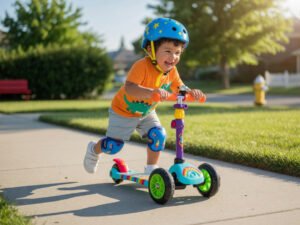
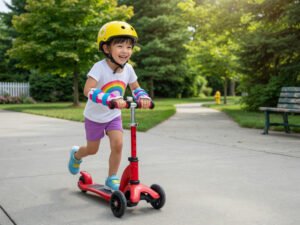
- Buy and gear up: Purchase the bike along with a properly fitted helmet (non-negotiable), knee pads, and elbow pads for beginners. Safety gear is part of the investment.
- Introduce gradually: Start on a flat, smooth surface. Let your child walk the bike first. Don’t push them to glide — the gliding comes naturally once they’re comfortable. Short, frequent sessions (15–20 minutes) work better than long occasional ones.
The right balance bike is one that fits today, challenges your child to grow, and sparks a love of riding that will last for years. At Kids Bikes N Trikes, we’ve helped thousands of families make this choice — and the joy on a toddler’s face the first time they lift both feet and glide is genuinely something you don’t forget.
Take your time, measure carefully, and don’t be afraid to ask for help. The best balance bike isn’t the most expensive one — it’s the one that fits your child right now and makes them excited to ride again tomorrow.
—